
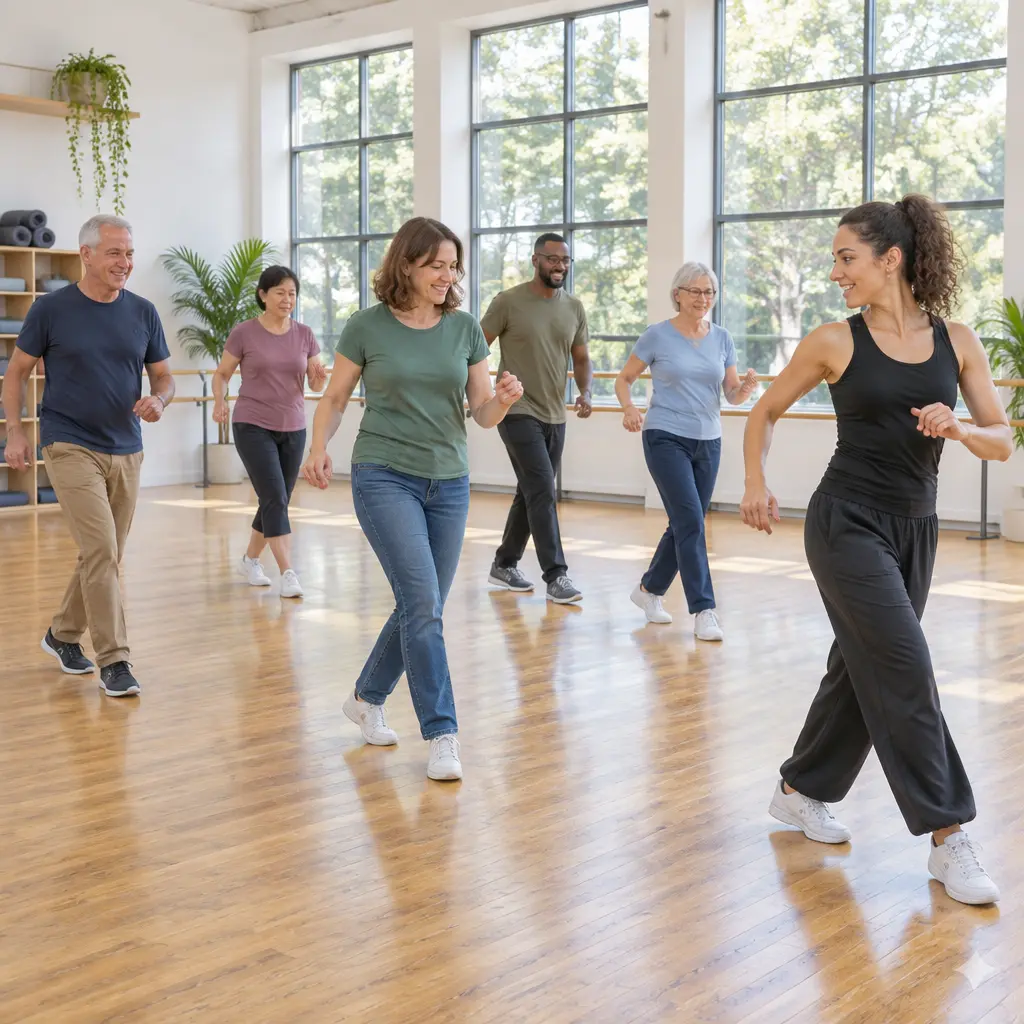
Dance is a physical art and social practice built from patterned movement, music, and expression. Starting dance as an adult can bring an unexpected mix of pleasure, confidence, social connection, and physical activity—not because adults need to become professionals, but because beginner classes make movement a learnable, low-stakes experience. Research supports dance’s potential benefits for fitness, balance, mood, and social participation, while adult beginners’ own progress often comes in small rewards: remembering a sequence, finding the beat, or feeling less self-conscious. This article explains why adult dance can be joyful, what kinds of classes newcomers can try, how to choose a welcoming setting, and what evidence can—and cannot—say about dance’s benefits.
Adult dance brings together movement, learning, and enjoyment
Adult dance is recreational or instructional dance undertaken by people who begin, return to, or continue dancing in adulthood. It may take place in a studio, community center, gym, cultural organization, or social venue. The key feature is not age or skill level: it is participation in dance for purposes such as enjoyment, expression, fitness, learning, or connection.
The joy can be surprising because beginners often expect to be judged on coordination or remembered choreography. In a supportive class, however, the goal is usually to practice, not perform perfectly. The Centers for Disease Control and Prevention (CDC) includes dancing among examples of moderate-intensity aerobic activity, while the World Health Organization (WHO) recommends that adults accumulate 150 to 300 minutes of moderate-intensity aerobic activity a week, or an equivalent amount of vigorous activity. Dance may contribute to that total, depending on its pace and duration; it is not automatically a substitute for every kind of exercise.
The relevance is broader than exercise. Dance asks people to coordinate attention, rhythm, memory, and movement while sharing space with others. A 2019 review in the British Journal of Sports Medicine reported that dance interventions were associated with improvements in health-related outcomes across varied populations, while also noting that the studies differed in their methods and dance styles. That is encouraging evidence, not a guarantee that every class will produce the same effects.
Adult dance supports physical activity and skill-building
Dance is a form of expressive movement in which the body follows, interprets, or creates patterns, often in relation to music. For a beginner, learning dance combines physical practice with skill acquisition: noticing a beat, repeating steps, adjusting posture, and gradually linking movements into sequences. The National Institute on Aging describes dancing as an activity that can help older adults stay active and maintain balance and strength; the exact demands depend on the style, pace, and individual dancer.
Different dance forms offer different entry points. Social dances such as salsa, swing, and ballroom emphasize partnered or group patterns; ballet and contemporary classes focus on technique and expressive movement; tap makes rhythm audible through footwork; and line dancing lets participants follow sequences without needing a partner. These categories overlap, and studios often adapt classes for beginners, different ages, or varied mobility.
Dance as aerobic movement
Aerobic dance involves sustained rhythmic movement that raises breathing and heart rate. The CDC’s physical-activity guidance lists dancing as one way to obtain moderate-intensity activity. Whether a particular class reaches moderate intensity depends on factors such as tempo, breaks, movement size, and a person’s fitness level. A useful practical check is the talk test: at moderate effort, a person can usually talk but not sing comfortably.
This makes dance a flexible option for people who find conventional workouts repetitive. A beginner might start with a gentle class, pause when needed, and increase duration or intensity gradually. People with health concerns, pain, balance limitations, or a long period of inactivity can ask a health professional about suitable activity and tell the instructor what modifications may help.
Dance as coordination and balance practice
Coordination is the ability to organize movement across body parts and in time; balance is the ability to maintain or recover stability. Many dance classes invite participants to shift weight, change direction, and coordinate steps with rhythm. These demands can make dance a form of movement practice, but a class should not be treated as a guaranteed fall-prevention program.
The WHO’s physical-activity recommendations for older adults include varied multicomponent activity that emphasizes functional balance and strength on three or more days a week to help maintain functional capacity and prevent falls. Dance may contribute to active movement, but people at higher risk of falling may need a class specifically designed for balance, an instructor trained to adapt movement, or guidance from a clinician.
Dance as a learnable adult skill
Learning choreography means encoding, recalling, and adjusting a sequence of movements. New dancers may initially need to watch the teacher closely or repeat a short phrase several times. That is ordinary skill acquisition, not evidence that someone lacks “natural rhythm.” Instructors can support learning by demonstrating movements from more than one angle, breaking combinations into sections, and offering simpler versions before adding speed or complexity.
A beginner’s progress is often easiest to notice through practical milestones: recognizing a recurring rhythm, completing a short combination, or recovering smoothly after losing a step. These small successes can make practice rewarding even when improvement is not linear.
Adult dance can create social connection and emotional rewards
Social dance is movement practiced with other people, whether partners, a group, or a class. Its social value comes partly from shared attention: dancers listen to the same music, follow common cues, and learn in the same space. A studio class may offer recurring contact with familiar people, while a community dance can provide a more informal setting.
The U.S. Surgeon General’s 2023 advisory on social connection describes social connection as important to individual and community health and identifies loneliness and isolation as significant public-health concerns. Dance is not a treatment for loneliness, and being in a group does not guarantee meaningful connection. Still, a regular class can create an opportunity for conversation, mutual encouragement, and a shared activity—especially when the environment is welcoming and participation is not overly competitive.
Confidence through low-stakes practice
Confidence in dance is often built through repeated exposure to movement and mistakes. A beginner class that normalizes missed steps lets participants practice without needing to prove talent. The confidence gained may be specific—feeling more comfortable moving in front of others—rather than a universal boost to self-esteem, and experiences vary.
A useful way to reduce pressure is to choose a class explicitly labeled beginner, introductory, or foundations. Before enrolling, ask whether students are expected to perform, whether partners rotate, and whether modifications are offered. Those details can matter more to comfort than the dance style itself.
Mood, music, and enjoyment
Dance combines physical exertion with music and expressive choice, which may make it feel different from exercise organized around repetitions or equipment. Reviews of dance interventions have found promising associations with psychological well-being, but research varies in population, duration, and study design. It is therefore more accurate to say dance can be enjoyable and may support well-being than to claim it reliably prevents or treats depression or anxiety.
For many adults, enjoyment is itself a practical advantage: an activity people look forward to may be easier to return to. Choosing music and movement that feel inviting, rather than selecting a class solely for calorie estimates, can help make a new routine sustainable.
Adult beginners can choose a dance style that fits their needs
A dance style is a recognizable movement tradition or teaching format, with its own music, technique, and social conventions. There is no single best style for every adult beginner. The right starting point depends on the person’s goals, comfort with partners or performance, access, budget, and physical needs.
Social and partner dance
Salsa, swing, ballroom, and other partner dances teach shared patterns, timing, and communication. Many introductory classes rotate partners, while others allow participants to stay with a chosen partner or dance solo. Ask about the class format in advance, particularly if partner rotation or close contact would affect your comfort.
Solo and follow-along dance
Line dancing, beginner hip-hop, jazz, and many community dance-fitness classes can be done without a partner. These formats may suit people who prefer to learn sequences as part of a group without navigating partner roles. Some classes move quickly, so a trial session or a conversation with the instructor can help establish whether the pace is appropriate.
Technique and expressive dance
Ballet, contemporary, tap, and other technique-based classes build movement vocabulary through structured instruction. Adults can begin these forms without childhood training, though the class should be genuinely designed for adult beginners rather than simply open to all ages. Look for clear progressions, realistic expectations, and options to modify movements.
A welcoming class makes starting dance as an adult easier
A beginner-friendly class is one that explains expectations, teaches fundamentals progressively, and treats different bodies and learning speeds with respect. Before signing up, check the instructor’s experience, class size, floor surface, footwear guidance, accessibility, and cancellation policy. A short trial class can reveal whether the teaching style and atmosphere feel right.
Real-world examples show how varied adult entry points can be. A community center may offer low-cost line dancing for people who want an easy social introduction; a studio may run a six-week salsa course for newcomers; and a dance-fitness class may focus on continuous movement rather than detailed technique. These are examples of formats, not evidence that any one setting is universally effective. The best option is one a participant can access, afford, and enjoy.
Use these practical steps to get started:
- Choose one goal for the first month, such as learning basic steps, enjoying music, or meeting people.
- Try a beginner or introductory class and ask about pace, modifications, and footwear.
- Wear comfortable clothing that allows movement; follow the instructor’s guidance on shoes and avoid footwear that grips or slides unpredictably on the floor.
- Arrive a little early so you can tell the instructor you are new and mention any movement limitations.
- Give yourself permission to pause, observe, or simplify a step. Progress does not require matching the most experienced dancer.
- After class, notice how you felt during and afterward, then decide whether to return or try another format.
Dance can involve falls, joint strain, or overexertion, just like other physical activities. Increase challenge gradually, follow studio safety instructions, and stop if you experience concerning symptoms. A qualified instructor should be willing to explain alternatives rather than pressuring participants to push through pain.
Conclusion: the unexpected joy is in the process
Starting dance as an adult can combine aerobic movement, coordination practice, skill learning, music, and social participation. The CDC recognizes dancing as one possible form of moderate-intensity activity, while WHO guidance underscores the value of regular movement and, for older adults, balance-focused activity. Research on dance and well-being is promising but varied, so benefits should be understood as possibilities rather than promises.
The most important measure of a first class is not whether every step is correct. It is whether the setting feels safe enough to learn and enjoyable enough to return. Look for a welcoming beginner class, ask for modifications when needed, and let progress happen one sequence at a time. For further guidance, explore local community-center programs, introductory studio courses, and public-health activity recommendations.
Sources: Centers for Disease Control and Prevention, “Adult Activity: An Overview,” https://www.cdc.gov/physical-activity-basics/guidelines/adults.html; World Health Organization, WHO Guidelines on Physical Activity and Sedentary Behaviour, 2020, https://www.who.int/publications/i/item/9789240015128; Merom et al., “Dance participation and health-related outcomes among older adults: a systematic review and meta-analysis,” British Journal of Sports Medicine, 2019, https://bjsm.bmj.com/content/53/15/945; National Institute on Aging, “Exercise and Physical Activity,” https://www.nia.nih.gov/health/exercise-and-physical-activity; U.S. Surgeon General, Our Epidemic of Loneliness and Isolation: The U.S. Surgeon General’s Advisory on the Healing Effects of Social Connection and Community, 2023, https://www.hhs.gov/sites/default/files/surgeon-general-social-connection-advisory.pdf.