
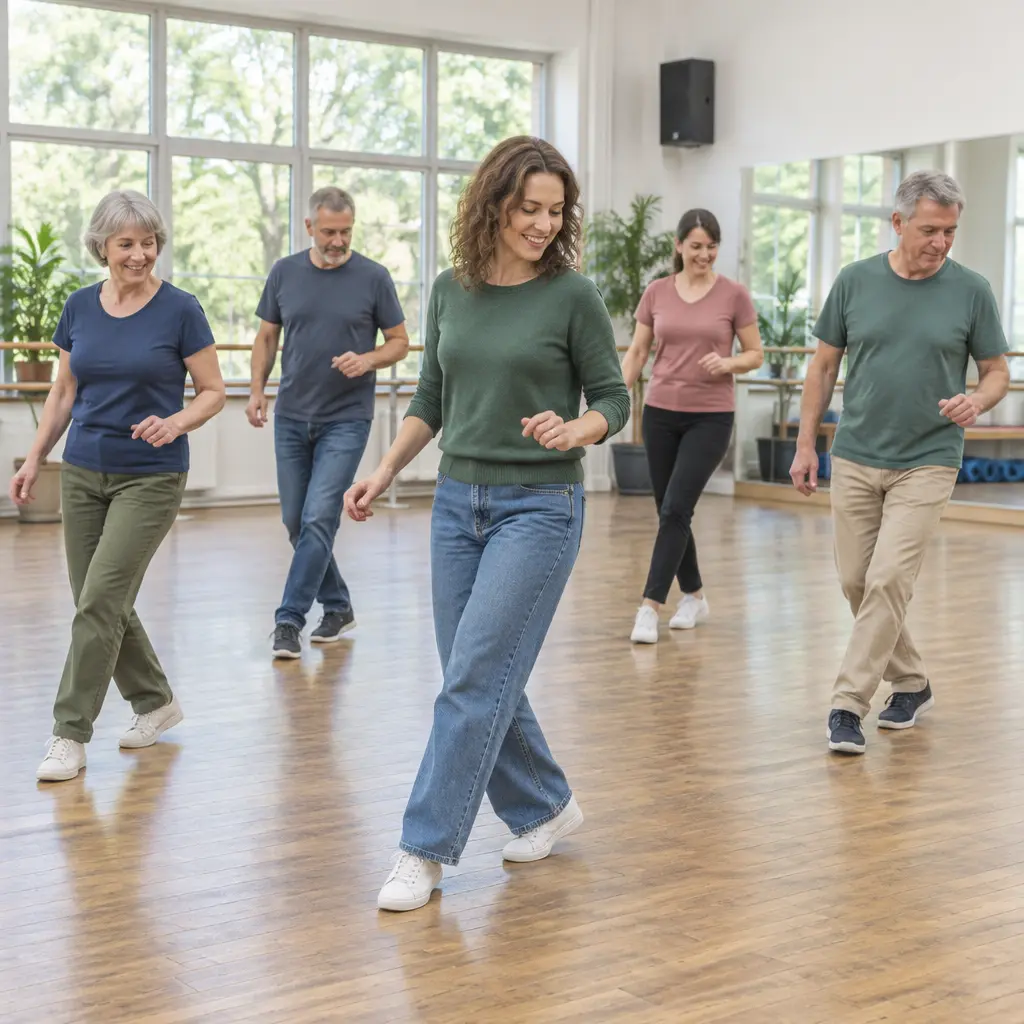
Dance can build confidence in adults by offering repeated, manageable opportunities to learn skills, express emotion, connect with other people, and become more comfortable being seen. Confidence is not a guaranteed result of taking a class, and research does not establish one universal confidence boost from dance. However, studies of dance and related movement programs report benefits in areas such as mood, social connection, physical self-perception, and well-being—all of which can support self-confidence. This article explains how those benefits develop, what kinds of dance may help, what the evidence can and cannot show, and how adults can choose a welcoming class.
Dance supports adult confidence through skill, movement, and connection
Adult dance is the practice of learning or performing movement patterns, either individually or with others, for recreation, fitness, artistic expression, or social participation. Confidence means a person’s belief in their ability to act, learn, and participate; it can be specific to a situation rather than a fixed personality trait. In dance, that may mean trusting one’s body, attempting an unfamiliar step, improvising, or joining a group without expecting perfection.
The World Health Organization’s 2019 report on arts and health reviewed evidence from more than 3,000 studies and described multiple ways arts participation may support health and well-being. Dance is one form of arts participation, but the report does not mean every dance class produces the same outcome. A 2018 review in the British Journal of Sports Medicine also found that dance interventions were associated with improvements in psychological and cognitive outcomes across varied populations, while noting differences among study designs and dance programs.
These findings matter because adults may encounter barriers to confidence—including fear of judgment, changes in physical ability, social isolation, or the belief that they are “too old” or “not coordinated.” Dance can provide a structured setting to practise at an individual pace. The most useful measure is not whether someone looks like a professional, but whether they feel increasingly able to participate, learn, and enjoy movement.
Dance builds adult confidence through mastery and self-efficacy
Self-efficacy is a person’s belief that they can carry out a particular action or meet a particular challenge. Psychologist Albert Bandura defined it as beliefs about one’s capabilities to organize and execute actions needed to manage prospective situations. Applied to dance, self-efficacy can mean believing, “I can learn this sequence,” rather than assuming, “I have no rhythm.” Each small success—remembering a step, keeping time, or returning after a mistake—can provide evidence that ability grows with practice.
A dance class naturally contains achievable challenges: copying a short combination, coordinating arms and feet, or moving to a new rhythm. When instructors break skills into steps and offer options, participants can experience progress without needing to master everything at once. This gradual learning is one reason a beginner-friendly class may be more confidence-supporting than a setting focused on comparison or performance alone.
Progress through beginner-friendly skill practice
Skill mastery is improvement gained by practising a task and noticing that it becomes more manageable. A beginner might first follow only the footwork, then add arm movements, and eventually complete the sequence to music. Tracking small gains—such as attending regularly or remembering a new pattern—makes progress visible and helps replace all-or-nothing judgments with a learning mindset.
Comfort with mistakes and gradual exposure
Gradual exposure means approaching a situation that feels uncomfortable in manageable stages. An adult who feels self-conscious may begin at the back of the room, choose a low-pressure class, and later try dancing nearer the center or joining a social event. Mistakes are part of learning choreography; a supportive teacher treats them as ordinary feedback, not proof that a student does not belong.
Mastery can also connect to the physical experience of movement. As participants learn balance, timing, and coordination, they may feel more capable in their bodies. That sense of capability leads naturally to another confidence pathway: changes in mood and physical self-perception.
Dance strengthens confidence through mood and body awareness
Body awareness is the ability to notice sensations, posture, balance, and movement. Dance invites participants to attend to what their bodies can do rather than judging only how they look. It can also provide a structured way to express energy and emotion. These experiences may support confidence, although they should not be presented as a substitute for medical or mental-health care.
The Centers for Disease Control and Prevention recommends that adults aim for at least 150 minutes of moderate-intensity aerobic activity each week, alongside muscle-strengthening activity on two days. Some dance classes may contribute to aerobic activity, depending on their intensity and duration. Meeting physical-activity guidance is a health benefit; it does not by itself prove that a person will become more confident.
Enjoyment, energy, and emotional expression
Dance combines music, movement, and attention, which can make physical activity feel enjoyable rather than purely task-oriented. A 2024 systematic review and meta-analysis in BMJ Open examined dance interventions for adults and reported positive effects on psychological outcomes, including well-being and depressive symptoms, across the included studies. The authors’ findings support dance as a promising activity, but differences in populations and program formats mean results should not be treated as a guaranteed personal outcome.
A more functional view of the body
Functional body appreciation means valuing the body for experiences and abilities, such as turning, reaching, balancing, or moving with music. Dance may help shift attention toward these capabilities. This approach can be especially useful for adults who feel disconnected from exercise because of appearance-focused messages. Classes that welcome different body sizes, mobility levels, and skill backgrounds are more likely to make movement feel accessible.
Mood and body awareness are personal experiences, but dance also takes place in a social environment. For many adults, the chance to participate alongside others is a distinct source of confidence.
Dance builds social confidence through shared participation
Social confidence is the comfort to interact with others, contribute to a group, and take part in shared activities. In a dance class, participants may learn together, take turns, follow a partner’s cues, or celebrate a group performance. These repeated interactions can make social participation feel more familiar, particularly when the class culture is respectful and noncompetitive.
A 2017 randomized controlled trial published in Frontiers in Psychology studied older adults who took part in a group dance program and found improvements in social connection and well-being-related measures compared with a control condition. The participants and program were specific to that study, so the result should not be generalized to every adult or dance setting. It does, however, illustrate how group movement can combine physical practice with opportunities for connection.
Partner and social dance
Partner dance—including salsa, swing, ballroom, and tango—uses shared timing and communication. Participants practise leading, following, personal boundaries, and adapting to another person’s movement. These skills may make social interaction feel less intimidating because the activity provides a common focus. A well-run class explains consent and offers ways to practise without pressure to dance with a particular partner.
Group and community dance
Group dance includes styles such as line dance, folk dance, community choreography, and many fitness-based classes. Participants can feel part of a group while choosing how prominently to take part. Community programs may also connect people across age groups and experience levels. The confidence benefit is most plausible when belonging is encouraged and comparison is kept low.
Different forms offer different social demands: solo practice may feel safer for someone who wants privacy, while partner or group dance may provide more interaction. Choosing a format that matches one’s comfort level makes it easier to sustain participation and build confidence over time.
Dance styles offer different routes to adult confidence
No single dance style is best for every adult. The right choice depends on a person’s interests, access needs, physical condition, and preferred level of social interaction. Dance can be adapted, and participants can ask instructors about modifications before enrolling.
- Ballroom and Latin dance offer structured steps and partner interaction.
- Hip-hop and street styles often emphasize rhythm, personal style, and expressive movement.
- Ballet and contemporary classes develop technique, balance, and control, with beginner options available in some studios.
- Line dance and folk dance provide repeatable patterns that can be learned as a group.
- Dance fitness classes prioritize continuous movement and may suit people seeking an energetic workout.
- Improvisational and creative dance encourage participants to explore movement without relying on a fixed sequence.
For adults new to movement, a low-impact class or seated dance session may be an appropriate starting point. Anyone with a health condition, pain, balance concerns, or recent injury can consult a qualified health professional and tell the instructor about relevant limitations. An inclusive teacher should offer adaptations without making participants feel singled out.
Real-world evidence requires a balanced view
Research on dance and well-being includes different styles, session lengths, participant ages, and outcome measures. Some studies measure mood or quality of life; others assess physical function, cognition, or social connection. Those outcomes can relate to confidence, but they are not identical to a direct measure of confidence. This distinction matters when interpreting claims about what dance can do.
The World Health Organization’s review of arts and health provides broad support for the potential value of arts participation, while dance-specific reviews offer more focused but still varied evidence. Small studies, short follow-up periods, and differences between programs can limit how confidently results apply to all adults. Dance is best understood as a promising, adaptable activity—not a guaranteed treatment or a quick fix for low self-esteem.
A practical way to assess personal benefit is to notice changes over several weeks: Is it easier to attend? Can a sequence be followed with less hesitation? Does movement feel more enjoyable? Are interactions with classmates becoming more comfortable? These observations help adults evaluate progress without relying on appearance or comparing themselves with experienced dancers.
How adults can choose a confidence-building dance class
- Look for a class explicitly described as beginner, open-level, adaptive, or welcoming to adults returning to movement.
- Ask whether the instructor demonstrates modifications and allows participants to pause or observe.
- Choose a style that genuinely interests you; enjoyment makes regular attendance more sustainable.
- Try a single class before committing to a long course, if the provider offers a trial session.
- Set a process goal, such as attending once a week or learning one short combination, rather than aiming to perform perfectly.
- Notice how the class treats mistakes, different bodies, and varied skill levels. A respectful environment is part of the experience.
If a class increases distress or physical discomfort, it is reasonable to change the format, speak with the instructor, or stop. Confidence grows through safe and meaningful participation, not through forcing oneself to tolerate an unsuitable environment.
Conclusion: dance can help adults trust their abilities
Dance can support adult confidence through self-efficacy and skill mastery, mood and body awareness, and social connection. Research reviews and individual studies suggest potential benefits for well-being, while also showing why outcomes depend on the person, program, and setting. Dance is not a guarantee of confidence, but a welcoming class can provide repeated chances to learn, express, connect, and recognize what the body can do.
Adults interested in trying dance can begin with a beginner-friendly class, choose a style they enjoy, and focus on participation rather than perfection. For further reading, consult the World Health Organization’s arts-and-health review, the CDC’s physical-activity guidance, and peer-reviewed research on dance interventions. The first step can be as simple as attending one class and giving yourself permission to learn.
Sources: World Health Organization, What is the evidence on the role of the arts in improving health and well-being? A scoping review, 2019, https://www.who.int/europe/publications/i/item/9789289054553; Fong Yan, A., et al., “The effectiveness of dance interventions on physical health outcomes compared to other forms of physical activity: a systematic review and meta-analysis,” British Journal of Sports Medicine, 2018, https://bjsm.bmj.com/content/52/10/657; Bandura, A., “Self-efficacy: Toward a unifying theory of behavioral change,” Psychological Review, 1977, https://doi.org/10.1037/0033-295X.84.2.191; Centers for Disease Control and Prevention, Adult Activity: An Overview, https://www.cdc.gov/physical-activity-basics/guidelines/adults.html; Sheppard, A. and Broughton, M. C., “Promoting well-being and health through active participation in music and dance: a systematic review,” International Journal of Qualitative Studies on Health and Well-being, 2020, https://doi.org/10.1080/17482631.2020.1732526; World Health Organization, WHO Guidelines on Physical Activity and Sedentary Behaviour, 2020, https://www.who.int/publications/i/item/9789240015128.