
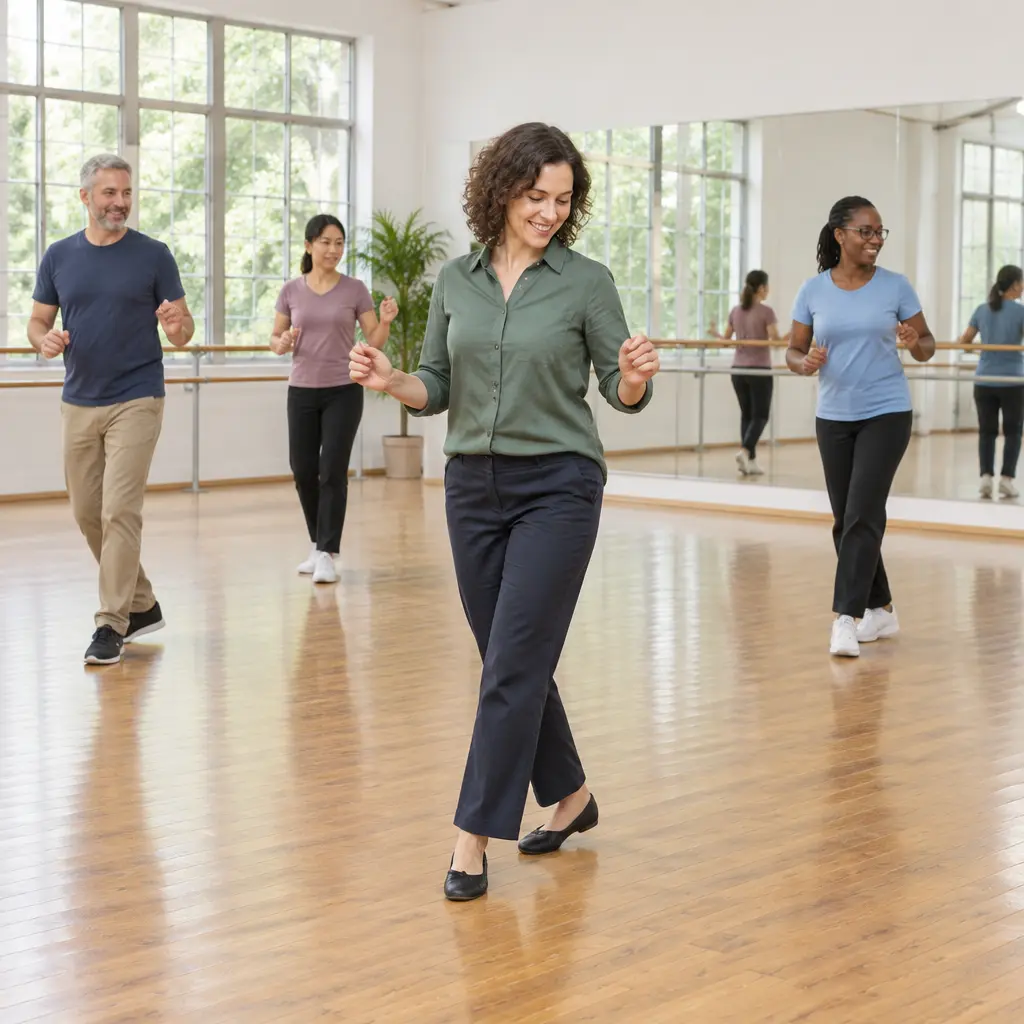
Adult dance learning is the process of building movement skills, timing, and confidence after childhood. For many beginners, dancing comfortably takes about 8 to 12 weeks of regular practice—often enough to follow a basic rhythm and manage simple steps—while feeling at ease across different songs or social settings may take several months. There is no universal timetable: prior movement experience, practice frequency, teaching quality, and what “comfortable” means all matter. Research on motor learning supports the value of repeated, spaced practice, but it does not establish a fixed number of weeks for learning to dance.
Dance learning time depends on what “comfortable” means
Dance comfort is a practical combination of basic skill and reduced self-consciousness, not a formal proficiency level with one accepted measurement. A useful beginner definition is being able to keep time, perform a few foundational movements, recover after losing the beat, and continue without feeling overwhelmed. That goal is distinct from mastering choreography, improvising confidently, or dancing several styles.
The Centers for Disease Control and Prevention includes dancing among examples of physical activity, but its activity guidelines do not prescribe a learning timeline. Likewise, motor-learning research describes how practice supports skill acquisition rather than promising a particular result by a particular date. The estimate of 8 to 12 weeks is therefore a practical planning range—not a scientific guarantee.
Basic comfort: following a beat and learning a few steps
Basic comfort means recognizing the pulse of familiar music, repeating a simple step pattern, and staying in motion even when a step goes wrong. With one or two beginner lessons a week and short practice sessions between them, some adults notice progress within a few weeks. Reaching a dependable beginner level often takes longer, commonly around two to three months of consistent practice.
Social comfort: adapting to music and other people
Social comfort adds skills such as adjusting to different tempos, navigating a shared floor, and responding to a partner or group. These demands make the goal broader than memorizing one routine. A person may feel comfortable in a familiar class after a few weeks but need several months of varied practice to feel relaxed at a party or social dance.
Performance confidence: choreography and improvisation
Performance confidence involves remembering longer sequences, presenting movements deliberately, or improvising with control. It is a more advanced and subjective target, so progress may continue for years. Beginners do not need this level to enjoy dancing: learning a small set of adaptable movements can be enough to participate comfortably.
Practice frequency shapes how long adult dance learning takes
Practice frequency is the number and spacing of dance-learning sessions over time. Motor-learning reviews, including research by Nicolás R. H. and colleagues on practice scheduling, discuss how distributed practice can support retention compared with packing all practice into one session. This principle is relevant to dance because timing and coordination benefit from repeated attempts with opportunities to rest and revisit the movement.
A realistic weekly practice plan
A manageable plan is one or two lessons each week, plus two or three short home practices of roughly 10 to 20 minutes. A short session can focus on one element—such as stepping to a steady beat, changing direction, or repeating a basic pattern—rather than trying to learn an entire routine. Consistency is generally more useful than a single long practice followed by weeks away.
For example, an adult attending one weekly beginner salsa class might spend 15 minutes twice during the week reviewing the basic step and listening for the music’s pulse. After several weeks, that learner may recognize the pattern more quickly and feel less dependent on watching the instructor. This is an illustrative example, not a guaranteed outcome.
Feedback, repetition, and recovery
Helpful feedback identifies one or two changes a learner can apply immediately, such as softening the knees or shifting weight fully onto a foot. Repeating a manageable movement, taking a brief break, and trying again can make practice less frustrating. If a class moves too quickly, asking the instructor to demonstrate slowly or practicing without music first can help establish the pattern.
Dance style and starting point affect the learning curve
Dance styles differ in their movement vocabulary, musical demands, and social conventions. A beginner may learn the essentials of a repetitive line dance sooner than the foundations of a partner dance involving turns, connection, and direction changes. These differences do not mean that one style is inherently easy for everyone; familiarity with its music and movements also matters.
Line, social, and partner dances
Line dances often use repeated sequences that learners can practice individually, making their basic patterns relatively straightforward to review. Social partner dances introduce additional tasks, including responding to another person and maintaining comfortable spacing. Ballroom, swing, salsa, and similar styles may therefore require practice with both the steps and the interaction.
Previous experience and individual differences
Adults with experience in sports, music, martial arts, or another dance style may find some components familiar. Rhythm, balance, coordination, confidence, accessibility needs, and the opportunity to practice can all affect progress. The National Institute on Aging notes that physical activity should be suited to an individual’s abilities and health circumstances; adults with health concerns or pain should consider advice from a qualified health professional before starting or intensifying activity.
Signs that an adult is becoming comfortable dancing
Comfort is easier to track through observable behaviors than through comparison with other dancers. A beginner may be making meaningful progress even if movements are not polished. The following signs can serve as a simple self-check:
- Keeping a steady pulse for part of a song.
- Remembering and repeating two or three basic movement patterns.
- Recovering from a missed step without stopping completely.
- Changing direction or adjusting movement to suit the available space.
- Feeling more willing to join a class or dance socially.
A simple progress chart can record practice dates, the movement worked on, and one thing that felt easier. Reviewing those notes every two to four weeks helps reveal improvement that may be hard to notice from day to day. The chart is a tracking tool, not a standardized assessment.
How adults can learn to dance comfortably sooner
The goal is not to rush but to make practice repeatable and encouraging. Choose a style connected to music you enjoy, find a beginner class with clear instruction, and ask for simpler variations when needed. Practicing foundational movement at a comfortable pace can build confidence before adding speed, turns, or longer combinations.
- Choose one style and one specific beginner goal, such as keeping time through a song.
- Attend lessons consistently and review the same fundamentals between classes.
- Practice in short sessions, increasing complexity only when the basics feel manageable.
- Use a mirror or video only if it helps; focus on how the movement feels as well as how it looks.
- Measure progress against your own earlier attempts, not against experienced dancers.
If a class creates persistent pain, dizziness, or unusual shortness of breath, stop and seek appropriate guidance. Comfort includes learning in a way that respects physical limits as well as emotional confidence.
Conclusion: adult dance comfort grows through steady practice
Many adults can expect to learn basic dance movements and feel more comfortable within roughly 8 to 12 weeks of regular lessons and practice, while social confidence across unfamiliar music and settings may take several months. These are planning estimates rather than research-established deadlines. The meaning of comfort, practice schedule, dance style, instruction, and individual starting point all influence the timeline.
Start with a small, enjoyable goal, practice consistently, and notice concrete signs of progress such as keeping time or recovering from a missed step. For further guidance, consult a beginner instructor and adapt activity to your abilities. Dancing comfortably is less about reaching a perfect endpoint than becoming willing and able to move with the music.
Sources: Centers for Disease Control and Prevention, Physical Activity Basics, https://www.cdc.gov/physical-activity-basics/; National Institute on Aging, Exercise and Physical Activity, https://www.nia.nih.gov/health/exercise-and-physical-activity; Cepeda, N. J., et al., Distributed Practice in Verbal Recall Tasks: A Review and Quantitative Synthesis, Psychological Bulletin, 2006, https://doi.org/10.1037/0033-2909.132.3.354