
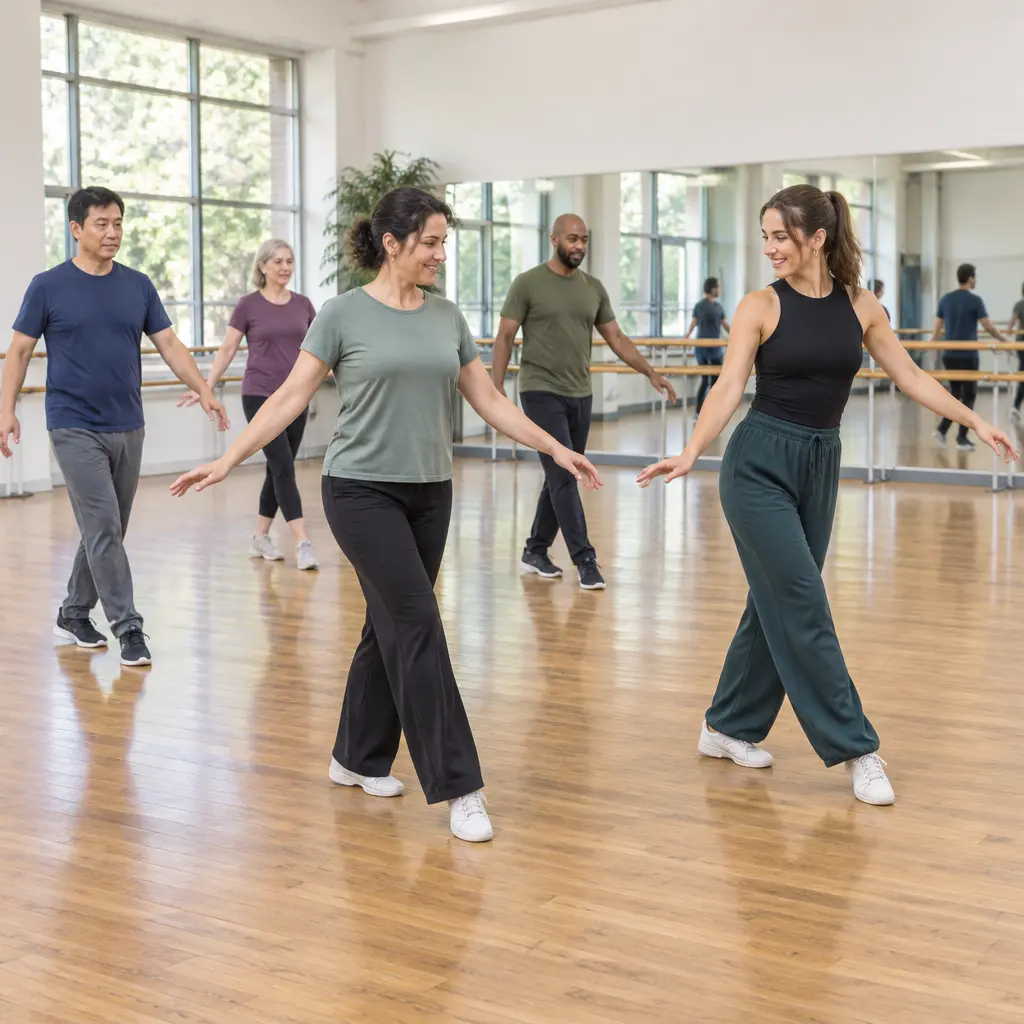
A dance teacher for adult beginners is an instructor who can teach foundational movement to people starting or returning to dance later in life. To find one who is a good fit, look for beginner-specific classes, clear and adaptable instruction, a welcoming approach to different bodies and experience levels, and transparent policies; then try a class and assess how it feels. This matters because the right teaching environment can make learning more approachable and sustainable: the National Endowment for the Arts’ 2022 Survey of Public Participation in the Arts found that 10.6% of U.S. adults had participated in dance during the preceding year. That figure describes participation, not the number of beginners, but it shows dance is a meaningful adult activity. The guide below explains what adult-beginner teaching involves, how to evaluate instructors and studios, and how to make a confident choice.
Adult-Beginner Dance Teaching: What Good Instruction Looks Like
There is no single official definition of “adult-beginner dance teaching.” In practice, it means teaching adults with little or no experience in a way that builds basic movement skills progressively, explains unfamiliar terminology, and offers suitable modifications. A beginner class should not simply be a faster or easier version of an advanced class; it should be designed around learning foundations.
The National Dance Education Organization’s standards emphasize developmentally appropriate dance education, including safe movement, creative practice, and learning dance concepts. Although its standards cover multiple ages and educational settings, the underlying principle is useful for adult classes too: instruction should match learners’ needs and build skills in a deliberate sequence. Relevant class types include absolute-beginner courses, introductory series, beginner drop-in classes, and adult recreational programs.
Progressive instruction and clear explanations
Progressive instruction introduces a skill in manageable parts before combining it into a longer phrase or dance. A teacher might demonstrate a basic step, explain weight transfer, let students practise slowly, and then add music or direction changes. This approach gives beginners opportunities to understand both what to do and how to do it.
Look for an instructor who demonstrates from more than one angle, breaks down combinations, explains terms, and checks whether the class is ready to move on. A useful question before enrolling is: “How do you structure a typical beginner class, and how do you help someone who needs extra practice?” Specific answers are more informative than general claims that the class is “for everyone.”
Adaptations, safety, and varied bodies
A welcoming class recognizes that adults differ in mobility, coordination, fitness, disability, prior experience, and comfort with physical contact. Adaptations might include smaller movements, a lower-impact option, a chair-based version, or permission to observe a partnered exercise before joining. The teacher should explain that students can choose an option without treating modification as failure.
The U.S. Centers for Disease Control and Prevention recommends that adults aim for at least 150 minutes of moderate-intensity aerobic activity each week, alongside muscle-strengthening activity on two days. Dance may contribute to physical activity, depending on its intensity and duration, but a beginner class should not be represented as a substitute for individualized medical advice. Ask about flooring, warm-ups, footwear, breaks, injury accommodations, and how the instructor responds when a movement causes discomfort.
A supportive learning climate
A supportive teacher treats mistakes as a normal part of learning, avoids shaming students, and gives feedback that is specific and respectful. For example, “Try placing your weight over the front foot” offers a practical adjustment; “You’re doing it wrong” does not. A well-managed class also makes expectations clear around late arrivals, partner rotation, touch, filming, and performance opportunities.
The National Institute on Aging notes that physical activity can support health and well-being as people age. That is not evidence that any particular dance class guarantees health benefits, but it reinforces why access, comfort, and a sustainable pace matter when choosing a class for long-term participation.
Evaluating a Dance Teacher: Credentials, Class Format, and Fit
Credentials can help establish a teacher’s background, but they do not by themselves show whether that person teaches adult beginners effectively. Dance forms vary, and qualifications may come from universities, professional organizations, private training programs, or years of practical experience. Evaluate credentials alongside teaching behavior, class structure, and the studio’s policies.
The U.S. Bureau of Labor Statistics describes dance teachers and choreographers as workers who teach dance techniques and create or direct dance performances. This broad occupational description does not set one universal credential for every recreational class. As a result, prospective students should ask about relevant training and experience in the specific style they want to learn, while also judging how clearly the instructor teaches.
Relevant experience and teaching skill
Relevant experience means more than being an accomplished performer. Ask how long the teacher has taught beginners, whether they have experience with adult learners, and what training or professional practice informs their instruction. A teacher who can explain foundational technique and adjust a lesson for mixed abilities may be a better fit than a performer whose expertise is primarily advanced choreography.
Useful signs include a clear class plan, demonstrations at a manageable pace, constructive feedback, and a willingness to answer questions. You can also ask whether the instructor has first-aid training or a process for handling injuries. These questions are practical checks, not a guarantee of teaching quality.
Choosing a class format and dance style
Class format affects how quickly a beginner can get help. A small, multiweek course may offer consistent progression and time for individual feedback, while a drop-in class can offer scheduling flexibility. Private lessons allow more individualized attention but usually cost more. Social dance classes may emphasize partner skills and practice, whereas ballet, contemporary, tap, or hip-hop classes may focus on different movement foundations.
Before signing up, check the course description for the intended level, prerequisites, class size, duration, and whether students can join after the first session. If you want a structured start, an “absolute beginner” series with a stated sequence of skills is often easier to evaluate than a class labeled only “open level.”
Cost, location, and studio policies
A good teacher is not a practical match if the class is difficult to reach, unaffordable, or incompatible with your schedule. Compare the full cost, including registration fees, shoes, clothing, practice sessions, and any required event charges. Ask about trial classes, refunds, missed-class policies, and whether there are lower-cost community options.
Check the physical space too. A suitable studio should have a clean, appropriate floor and enough room for students to move without crowding. For partner dance, ask how partners are assigned and whether opting out of rotation is allowed. A professional studio should be able to explain its expectations without pressuring you to buy packages or commit before you have tried the class.
Finding and Testing an Adult-Beginner Dance Class
Finding a class involves more than searching for the nearest studio. Start by identifying the style, schedule, budget, and learning environment you want, then compare several options. Studio websites, community recreation programs, adult education listings, dance associations, and recommendations from local dancers can all help generate candidates.
The following comparison chart can help organize your search. Rate each item from 1 (weak) to 5 (strong), and treat safety, respectful teaching, and beginner suitability as essential rather than optional.
Comparison chart: Beginner-specific course description — 1–5; clear, progressive teaching — 1–5; adaptations and respectful feedback — 1–5; convenient schedule and location — 1–5; transparent fees and policies — 1–5. Add brief notes beside each score so your decision reflects actual observations rather than a single impression.
Search with specific questions
Use search terms that include the style, location, and learner level, such as “adult absolute beginner salsa” or “beginner ballet class for adults.” Then confirm the details directly with the studio. Ask whether the class is genuinely suitable for people with no previous training, what a typical lesson covers, and whether there is a trial session.
Also ask about accessibility, footwear, class size, and missed lessons. If the answer is vague, dismissive, or focused mainly on selling a membership, consider contacting another provider. A short conversation can reveal whether the studio understands the needs of new adult students.
Use a trial class as an evidence check
A trial class lets you assess the instructor’s real teaching rather than relying on advertising. Notice whether the teacher introduces themselves, explains class expectations, offers clear demonstrations, and gives beginners time to practise. Pay attention to whether students can ask questions and whether corrections feel helpful rather than embarrassing.
After class, consider a few practical questions: Did I understand the main steps? Did the instructor offer a way to scale movements? Did I feel physically safe and socially respected? Was the pace challenging but manageable? One difficult moment does not automatically mean the class is a poor fit, but repeated confusion or discomfort is useful evidence.
Recognize warning signs and positive signs
Warning signs include a teacher who mocks mistakes, insists that every student move in the same way, ignores reports of pain, uses unwanted physical corrections, or promises rapid mastery without explaining the work involved. Be cautious if a studio refuses to disclose total costs or pressures you to sign a long contract before a trial.
Positive signs include a clearly identified beginner level, a logical class sequence, respectful options for different abilities, and a teacher who checks understanding. A strong instructor can challenge students while making it normal to pause, repeat a step, or ask for clarification.
Making the Choice and Building a Sustainable Start
Once you have compared options, choose the class that best balances teaching quality, comfort, access, and cost—not simply the one with the most impressive performance videos. Give yourself time to learn. Coordination, musical timing, balance, and confidence develop through repeated practice, and beginners do not need to master everything in the first lesson.
Set a realistic first-month goal
A useful first-month goal might be attending consistently, learning a small set of foundational steps, or becoming more comfortable following musical counts. Such goals focus on participation and learning rather than comparison with experienced dancers. Ask the teacher what progress is reasonable for the course and how to practise safely between sessions.
Reassess the fit as you learn
A class can be suitable at first and later become too basic, too advanced, or inconvenient. Reassess after several sessions: Are explanations still clear? Is feedback helping? Do you feel welcome and safe? If the fit is wrong, ask about another level, teacher, style, or format. Changing classes is a practical decision, not a failure.
Conclusion: Choose a Teacher Who Makes Learning Possible
Finding a dance teacher who works well with adult beginners means looking for progressive instruction, clear explanations, adaptable and safe teaching, a respectful class climate, and transparent practical arrangements. Credentials and performance experience can add context, but a trial class is often the best way to judge whether a teacher’s approach suits you. Compare options, ask direct questions, and pay attention to how you feel while learning. To take the next step, shortlist two or three local beginner classes and contact each studio about level, accessibility, fees, and trial sessions before enrolling.
Sources: National Endowment for the Arts, 2022 Survey of Public Participation in the Arts, https://www.arts.gov/impact/research/arts-data-profile-series/adp-34; National Dance Education Organization, National Core Arts Standards in Dance, https://www.ndeo.org/Learn/Standards; U.S. Centers for Disease Control and Prevention, Adult Activity: An Overview, https://www.cdc.gov/physical-activity-basics/guidelines/adults.html; National Institute on Aging, Exercise and Physical Activity, https://www.nia.nih.gov/health/exercise-and-physical-activity; U.S. Bureau of Labor Statistics, Dancers and Choreographers, https://www.bls.gov/ooh/entertainment-and-sports/dancers-and-choreographers.htm